Eddie Hall is now the World's Strongest Man in the World.
He is the winner of
2017 World's Strongest Man competition and announced his intention to retire
from the World's Strongest Man and return to lower weight competitions after achieving his lifetime ambition.
Eddie was born in
Newcastle-under-Lyme.
After training as a body-builder he entered the strongman
circuit and completed a strongman’s camp at the Iceman gym in Stoke-on-Trent.
In 2010 his fellow
Staffordshire competitor, Dave Meer, had to drop out of the England
Championships organised by Elite Strongman because of injury.
Meer arranged for
Hall to take his place which led to Hall making it into the 2010 finals, which
he won on his first attempt by half a point.
Earning a place at the
UK Strongest Man 2011 competition in Belfast which ended with Eddie Hall as the
UK’s Strongest Man, with Ken Nowicki in 2nd and Rich Smith in 3rd.
His win was
helped by Hall setting a new national record in the “Viking Hold”, hanging on
to 20 kg axles in each hand at full stretch for one minute and 18 seconds.
Winning the UK title
meant that Hall became the first choice to replace Jono MacFarlane of New
Zealand in the Giants Live Melbourne event in February 2012, when the
MacFarlane suffered a back injury.
Hall placed fourth in his first taste of
international competition.
In April 2012, Hall was
invited to compete at Europe’s Strongest Man, another Giants Live event.
This
was held at Headingley Carnegie Stadium, home of the Leeds Rhinos Rugby League
team and Hall found himself competing alongside six of the ten finalists from
World’s Strongest Man 2011, including two time World’s Strongest Man, Zydrunas
Savickas.
Hall finished in a respectable eighth place.
In July 2016 Eddie set a
new world record in the deadlift with a lift of 500 kilograms (1,100 lb),
besting the world record he had previously set at 465 kilograms (1,025 lb) earlier
that same day. The 500 kg lift made Hall pass out!
Currently, Eddie "The Beast" Hall is the world's strongest man 2017.
Eddie the Bulletproofbodies Team salute you. Video: https://www.youtube.com/channel/UC6IoVlmHWrWpJoAj7QKPeRA
Regardless of your body
type or the type of training that your body responds to best, hybrid muscle
training is all around, the most effective way to build muscle and get lean.
Often times, guys ask me how hybrid training carries over into sports. Well,
regardless of the sport, hybrid muscle training can help you be at the top of
your game.
But did you know that
there are also sports that by their very nature help you develop hybrid muscle?
Actually, any sport that simultaneously incorporates resistance and cardio can
be considered a hybrid activity. There are a number of sports that do
this-let's talk about some of them now.
American Football:
This is a
phenomenal sport that incorporates hybrid muscle training. The heavy pads
provide resistance and with the all the cardio that is involved in the sport,
it helps build type III or hybrid muscle. Other aspects of football that
involve hybrid training include blocking and training with sleds during
practice. All of these are activities that require endurance (the cardio part)
and the muscles to deliver sustained strength (the resistance part).
If you have any doubt
that football is an awesome hybrid training technique that can build a
powerful, muscular physique just look at guys like Adrian Peterson, Terrell
Owens or retired stars like Herschel Walker. All three have amazing
physiques-and it all is the result of hybrid muscle training.
Strongman:
This is
really is all about hybrid muscle training. Unlike say powerlifting where the
goal is to achieve your one-rep max, strongman training simultaneously requires
both strength and endurance. And as you know, the best way to develop these qualities
is through hybrid training. Examples of hybrid training activities that you see
in strongman competitions include the tire flip, log carrying, truck pulling
and the keg toss, among others.
And if you have any
doubt that strongman training won't build a powerful, muscular physique, just
take one look at Mariusz Pudzianowski and believe me, you'll eat your words.
Mixed Martial Arts
(MMA):
This one also incorporates hybrid muscle training-in fact, it's
essential. Look at the guys fighting in the UFC. Do you think jogging ten miles
a day carries over into the octagon and is going to help a guy get in shape for
fight? No-two minutes into the match and he'll be winded.
Why? Because the
successful fighters have developed hybrid type III muscle that has strength,
power and endurance. They need to develop long, sustainable strength. You don't
get that from ordinary training. When these guys train they have to mimic the
moves they'll be doing in the octagon-grappling, pulling and other things that
go on in a real fight. Guys like Ken Shamrock, Matt Hughes and Randy Couture
all have developed hybrid, type III muscle.
Highland games:
Seriously, this is about as hybrid as it gets. Have you ever seen these events?
Some of the hybrid training activities you'll encounter in Highland games
include the 56-pound shot put, the hammer throw with a 22-pound round metal
ball attached to a handle, or the caber toss. This would have to be the
signature event for the Highland games. The caber is a tapered log or pole that
varies in height (roughly 19′-22′) and weight (100-130 pounds). They lift it,
run with it and then heave it.
Lumberjack games:
You've probably seen these on TV before. These games require participants to
carry out feats of strength and endurance using extremely large and heavy logs.
This one is 100% hybrid.
Arm wrestling:
Your
probably wouldn't have thought of this one but yes, arm wrestling is most
definitely a sport that incorporates hybrid activities. After all, it does
require long-or sustained strength-and the only way to get that is through
hybrid training.
Track & field:
Besides the running, you've also got activities like the shot put and the
javelin throw. Both of these are activities that require both strength and
endurance.
Kettlebell
competitions:
Kettlebells have been around a long time. Their shape and handles
make them ideal for hybrid training. Some of the activities you'll see here
that require long strength include the clean and snatch or the one- or
two-armed kettlebell swing, among others.
CrossFit Competitions:
These are the kinds of routines that are often touted as the
"military" workouts so you'll often see military and law enforcement
guys participating in these events. Nearly all of the activities require
strength and endurance.
So there you have my
response to the question about how hybrid muscle training carries over into
sports. As you can see, not only does hybrid training and the development of
type III muscle fibers enhance your athletic performance in many sports some
sports are even hybrid in their nature.
Get my free report
entitled, The Warrior Physique - Building The Super Hybrid Muscle. Click to
learn how you can rapidly build muscle and burn fat at the same time.
Mike Westerdal is the
founder of Critical Bench, Inc. A free online weight training magazine.
Not everyone has the
luxury of training in a gym with a row of dumbbells at their fingertips. Not
everyone has the luxury of training at home with a few adjustable dumbbells.
Most people have just a
pair of dumbbells in their homes. Others have just one dumbbell in their homes
(like me). I grew up with just one dumbbell. I figured out how to train with
it, and so can you.
In fact, having one
dumbbell isn't so bad. It makes you more creative. You realize you have the
chance to think outside the box. Because of my lack of resources, I've become
very good at thinking outside the box to make life more convenient for me.
I no longer need fancy
gadgets or the latest fashionable items to make my life meaningful. I take what
I have and use. Live within my means. And my means, I assure you, are very
humble.
So, lets get on with
it! The following are some great exercises you can use to train with just one
dumbbell:
Dumbbell One Armed
Hanging Snatch
Stand with one dumbbell
held in one hand with your feet slightly wider than shoulder width apart. Hold
the dumbbell so that your arm is hanging straight down between your legs, with
your palm facing inward, towards the back of your body.
Squat down until your
knees are bent at a 90-degree angle. Hold the other arm off the side for
balance, or behind your back. Use a pelvic hip thrust to explosively push up
out of the squat and lift the dumbbell in a straight-line motion towards your
head.
Bend your elbows as you
continue to lift the dumbbell towards your head, keeping the dumbbell close,
but not too close, to the body. Keep raising the dumbbell up and past your head
until you arms are straight out above your head.
From this position,
reverse the motion, and bring the dumbbell back to starting position. Make sure
to lower yourself back into the squat position.
Dumbbell One Armed
Hanging High Pull
This movement is
exactly the same as the snatch, however you stop the movement as the dumbbell
gets close to your chest. Think of it as an explosive upright row. Make sure to
squeeze your lats as you bring the Dumbbell to the top position.
Dumbbell One Armed Step
Ups
Stand facing a bench,
chair, or sturdy object with a dumbbell in your hand. Place one foot on the
bench, press on the bench with the foot to bring your body up and place the
other foot on the bench.
Now both feet should be
on the bench. Step down with the initial foot, and follow up with the other
foot. Now, step back up with the second foot, and follow up with the first
foot.
So basically you're
alternating between which foot you step up with first. Because the one dumbbell
will off-set your center of gravity, this movement will be tougher and will
engage your abdominals more then the two-dumbbell version.
Make sure to switch hands
with the dumbbell every few repetitions.
Dumbbell One Armed
Military Press
This is a fairly simple
exercise to execute. You will most likely need to start off at a lighter weight
then you would using two dumbbells. Hold a single dumbbell with one hand up to
your shoulder.
Press the dumbbell over
your head. Pause, and return to starting position. You can either do this
movement seated or standing. Each version has its own advantage and
disadvantage.
One Armed Clean and
Press
Here's another explosive
movement. Start off the way you would performing a snatch or high pull. Perform
the movement as if you would a hang snatch, however, instead of returning the
dumbbell back to starting position, rotate your elbow so that it's facing in
front of you.
This is what you call a
"catch." When you pull the dumbbell off the floor, your elbow is
towards the side. Simply rotate the elbow so that it's pointing towards the
front of your body.
This is the
"clean" portion of the movement. At this point, the dumbbell should
be at shoulder level. From here, simply perform a one-armed military press.
Return to starting position.
One Dumbbell Golf Squat
Grab a dumbbell by the
handle with two hands. Squat down low so that the dumbbell is hanging between
your legs. Squat back up while twisting your torso and driving the dumbbell up
and to the right shoulder.
Keep your arms straight
throughout the movement. This is called the golf squat, because it almost feels
like your swinging a golf club during this movement. Perform it explosively and
alternate sides.
One Armed Dumbbell
Crunch
Lay down on the floor
as if you were performing a regular crunch. Hold a dumbbell straight out in
front of your body. Keep your other arm in a neutral position. Crunch upwards,
keeping the dumbbell above your head.
You should feel this
movement in your upper abs and obliques.
One Armed Dumbbell
Twisting Military Press
This is like the
military press, except for the fact that you are twisting your torso. Twist to
to the right and press the dumbbell over your head. Bring it back down to your
shoulder as you face to the front.
Repeat and twist to the
other side. Switch hands and repeat. This is another great movement that will
help engage your abs.
One Armed Dumbbell
Curls
Sometimes we all need
some extra arm work. Hold a dumbbell with one hand to the side of your body.
Bend your elbow to curl the dumbbell up towards your shoulder. Stop at the top
position, and slowly bring it down.
Repeat on the other
side.
One Armed Dumbbell
Split Squat
This movement is often
confused with a lunge. But, in a lunge, you lunge forward and down. In the
split squat, you place one foot in front of the other in a "split"
stance, and simply squat up and down in this position.
The movement requires
more balance than a lunge, and will be ten times harder when performed with
just one dumbbell.
For some great dumbbell
workouts, check out the Gladiator Body Workout. Coach Eddie Lomax has done a
great job of developing 6 high intensity 4-week programs that combine dumbbell
and bodyweight exercises.
To learn more about
this amazing program, check out my blog ShahTraining.com
You have permission to
publish this article in your web sites, ezines or electronic publication, as
long as the piece is used in its entirety including the resource box, all
hyperlinks (HTML clickable) and references and copyright infoand copyright info
Some of the old timers,
the men who did this before the invention of modern training equipment,
machines, steroids, etc., did some truly amazing feats. I mean freakishly
amazing! Things that haven't been duplicated in 100 years or so for some of
them. I think, in a conversation with a close friend the other night, I may
have hit on one of the key components of their training that allowed them to
perform so powerfully.
My key upper-body
exercise and one that you hear me talk about a great deal is the one-armed
press. This was also a staple of most of the old time lifters. I don't think
it's so much magic of that particular lift, but it is two factors that that
lift allows you to train that's the secret here. They are total body
unification (especially total body unification behind a single limb), and
maximum power, abdominal work (especially as it pertains to a unified body and
the sides of the abdominals).
I talk a great deal
about efficiency in my training. One thing I've been doing lately to increase
efficiency is to add a windmill every time I do a one arm press. Why? Well
because I've already got the weight pressed up and locked out overhead. I can
add in the windmill at that point without extra time being spent. Plus the
windmill simultaneously allows me to work my abdominals heavy, while focusing
on the sides and in a total body movement. I have noticed that by doing this I
feel stronger in other exercises, squats and pulls, and even the transfer of
core strength over to pressing. These are the types of movements that the old
time strongmen concentrated on. It allows you to build the muscles of the arms,
shoulder and back, while simultaneously building strength and flexibility in
the legs, hips, abdominals and back.
So how does this
transfer over to their amazing performances? Well first it eliminates a weak
link in the chain of strength of the human body. We all know that our back,
legs, etc., can only put out as much pressure as our abdominals can match. So
most of us do some kind of ab training, even though most of don't really do it
heavy enough. You see the legs and back can put out a tremendous amount of
pressure and if you don't train the abs with the same weight you'll never be
able to truly realize the potential of your legs and back. Also most of us
focusing on training the front of the abdomen if we do heavy abdominal training
and don't train the sides of the body with the same type of max weight and
effort. I've come to believe that many of us, even though our heavy squats and
deadlifts are going up, are still weak in the abdomen. Because I think that
we're not just missing lifts from pure abdominal failure, but the fact that our
obliques and front abdominals are not just as strong as our legs and back, is falsely
limiting to the strength that our legs and back will put out. I think this is
why you almost uniformly hear that when a lifter adds heavy abdominal work to
his routine, his squat and deadlift go up. Also why many of the modern
powerlifting systems focus so heavily on trunk strength. The front and sides of
your trunk need just as much if not more maximal strength training than the
back, and your shoulder girdle, hips and thighs. A pipe that has weak side
walls isn't very strong.
I think this type of exercise
also added to their performance by teaching the body how to totally focus its
power into a movement behind one limb. By doing that you make a movement such
as the one arm press carry the strength of not just the pressing muscles, but
you involve the whole body into this lift. By constantly training this you
teach the body to demonstrate a strength in which the unified whole is greater
than the sum of the individual parts. You are in essence teaching the body
efficient strength, because you are teaching it how to literally unify all of
its members and how to work together. Think of how this applies to the martial
artist and how much more powerful his strikes or throws could be if his whole
body can unify and transfer its power through one arm. Think of the football
player or the athlete of any sort. I think these two factors account for why
they were able to do feats that seem almost miraculous and is definitely a
missing factor in most modern training.
Bud Jeffries has much
more to teach on building super human strength and conditioning. Visit
http://www.strongerman.com were you can sign-up and receive additional tips
now.
You probably already
know that serious strongmen need all of the following to be successful:
Raw power
Supreme lower body
strength
Super stamina and
endurance
You may also know that
strongman workouts should be:
Fast and efficient
Goal oriented
A way to get an edge on
your competition
And that's why I'm
recommending that every strongman who wants to be the best add the following
workout to their training.
When I look at
Strongman competitions, I see the need for a unique combination of strength,
speed, power, stamina and (maybe most importantly) mental toughness.
Your training should
reflect these needs. You shouldn't be told to waste your time on stuff that
doesn't work. You shouldn't be told about the latest shiny, chrome-covered
machine, or to use long, boring (and useless) cardio, or just about anything
else coming out of those mirrored, carpeted social clubs that dare to call
themselves gyms.
No, what you need is
something "old school." An exercise that is simple yet effective. One
that can address all of the needs listed above and bring you to a higher level
in your training.
Because of all of this,
I strongly suggest you add hill sprints to your training. Here's why:
First of all, hill
sprints are a great way to develop power. They are a perfect blend of strength
training and sprinting. And, as you know, training strength and speed together
are the best way to develop the power necessary for competition.
Running hill sprints
can train your muscles to fire fast and strong - to increase both the speed and
the strength of contraction. This training will help you develop the power
necessary for many of the traditional strongman events. Your performance in loading,
Atlas stones, truck pulling, the stone lift, the log throw, and the weight
throw can take off like a rocket from the speed/strength of hill sprints.
Secondly, hill sprints
build strength in muscle groups essential to strongman training. Most importantly,
the hips, glutes, quads and calves. Muscles needed for pushing, pulling and
lifting involved in events such as the log or stone press, the stone lift, car
rolling and tire flipping.
Even though you train
these muscles already for these events, hill sprints add different stresses and
demands on those muscles. Hills are a great way to "confuse" your
muscles and force them to adapt. These sprints will ask your muscles, not only
to be strong, but to be strong and explosive at the same time. An excellent way
to break through a plateau in your workouts.
The third reason to
hill sprint is that it's an excellent way to develop stamina and endurance
needed for long training sessions and (even more demanding) competitions.
It's a training method
that pushes your heart and lung capacity to new limits, increasing their volume
and allowing you to move more oxygen in and out of your body (and to pump more
blood to your muscles when they need it most). Training your heart and lungs in
this way can also help you recover faster between trys or events.
And all without doing
what you may think of as "cardio." It used to be thought that you
could only improve your endurance by training like a marathoner with long, slow
distance. Who wants to look like a marathoner? All that training does is shrink
your muscles and make you look like a skeleton. Good thing is that science is
now proving that higher intensity training like hill sprinting can give you
even better results than plodding along doing "roadwork."
Think of how much
better your farmer's walk, car walk, crucifix, or Hercules hold can be when you
can stay stronger... for longer.
These are only 3 of the
benefits you can get by hill sprinting. In Part II, we'll look at how hill
sprints can help you fit all of your training into your busy schedule, give you
an edge on your competitors and develop your mental toughness to a point where
any goal is possible. See you then.
Tim Alan Kauppinen, or
Coach K, has over 20 years experience as an athlete and coach. He has worked with
athletes of all ages and abilities in track and field, basketball, speed
training and strength and conditioning after graduating from the University of
Wisconsin - Madison with a coaching emphasis. This has given him the privilege
and the opportunity to coach athletes who have become conference champions,
state champions and Division I college players. Coach K is the author of the
Uphill Fitness Training, Ultimate Insider Speed Training Secrets and Iron Shins
programs. He also publishes a FREE daily training email newsletter. Tim can be
contacted through his website at
http://www.makesyoufast.com/power_hill_sprint.html
Sandbag training is an
amazingly versatile tool. They're unique in their feel, and some very different
types of drills can be performed within sandbag training. The number one
question that people ask me is "what are the best drills to perform in
sandbag training?" While that depends on various factors (i.e. goals,
training level, etc.), there are some foundational drills that make sandbags
very distinct.
Shoulder squat to
opposite side press
Until I come up with a
better name for this drill, I'll name it after the movement performed. This may
simply be one of the best hybrid drills to use in sandbag training. You perform
all of the important aspects of lifting-the pull, squat, and press. However,
you do all of them to one side of the body. Resting the sandbag on the shoulder
is very different from using kettlebells or even dumbbells. By actually placing
the load on the shoulder, the body is truly forced to stabilize across all
planes of the movement. This also greatly challenges the core in the most
functional way (resisting movement and maintaining posture). Lastly, the
pressing movement performed in this series can't be done with any other
implement. Your center of gravity changes drastically, and you aren't in the
most advantageous position to press. In other words, a whole lot of fun!
Shoulder Sandbag get-up
Great exercises like
get-ups are no longer forgotten drills thanks to Pavel Tsatsouline's
reintroduction of the kettlebell. Using a kettlebell, dumbbell, or even
barbell, in this drill, the challenge is to stabilize the shoulder joint while
you move. However, using sandbag training, the shoulder isn't the primary
focus, but rather more intensity is placed through the torso. This means you
can add more load to the trunk, and the dynamics of the movement change
greatly. The ability to be fluid and mobile while holding a 100-lb plus sandbag
not only builds a solid core, but also improves your strength-flexibility.
Half-moon snatch
Of course, the snatch
exercise is nothing new. With most implements, this drill is performed with the
weight in front of the body. This can also be performed using a sandbag, but
for a twist, we actually perform more of a side bending version. Since most
injuries occur in the planes of motion that we don't train, this is a very
helpful drill for improving the hips and torso. By keeping the weight of the
body by the bag, you explode and lift the bag up and over the head to the other
side. You'll find that the drill must be done by driving the hips into the
ground, not trying to lift the bag with the back. The half-moon snatch is
amazing for all athletes, especially combative athletes.
Overhead sandbag lunge
Some aren't big fans of
overhead lifting. While we could argue all day the validity of such an idea, we
can probably agree that some level of overhead strength is necessary for all
individuals-athletes and non-athletes alike. A very simple and safe way to start
building overhead shoulder stability is to perform the overhead lunge. For
some, this won't seem like a new lift because it has been commonly performed
using barbells and dumbbells in the past. However, sandbags add a new
dimension. Because of the non-conforming nature of sandbags, it's a greater
challenge trying to keep the weight perfectly balanced overhead. The bag will
slightly shift on every repetition causing the lifter to stabilize not only the
shoulders, but the trunk and hips as well. You'll be amazed by how many
people's entire body shakes while performing this drill.
Sandbag takedowns
This is a very unique
drill. I wanted a drill that could be performed using the whole body with
explosive rotational power. That's where this drill was born. By using a jump
stretch band and attaching it to the handles of the sandbag, you can create a
rotational drill with a very "live" feeling.
Hopefully, this opens
your eyes to some of the amazingly effective drills you can create with one of
the world's oldest tools-sandbag training!
Josh Henkin is the
creator of the Ultimate Sandbag Training programs one of the most dynamic and
highly sought out functional fitness programs. Find out how sandbag training
can accelerate your fitness programs.
The Body Power Expo was also home to
the Body Power Games which is a high level CrossFit event that drew crowds as
the struggled to choose which event to observe next.
The NEC in Birmingham was buzzing
with Body Builders, Power Lifters, Olympic Weight lifters, Strongmen, Gymnasts
and CrossFitters.
From these arduous physical
activities there was no shortage of people wanting advice and treatment for
musculo-skeletal injuries.
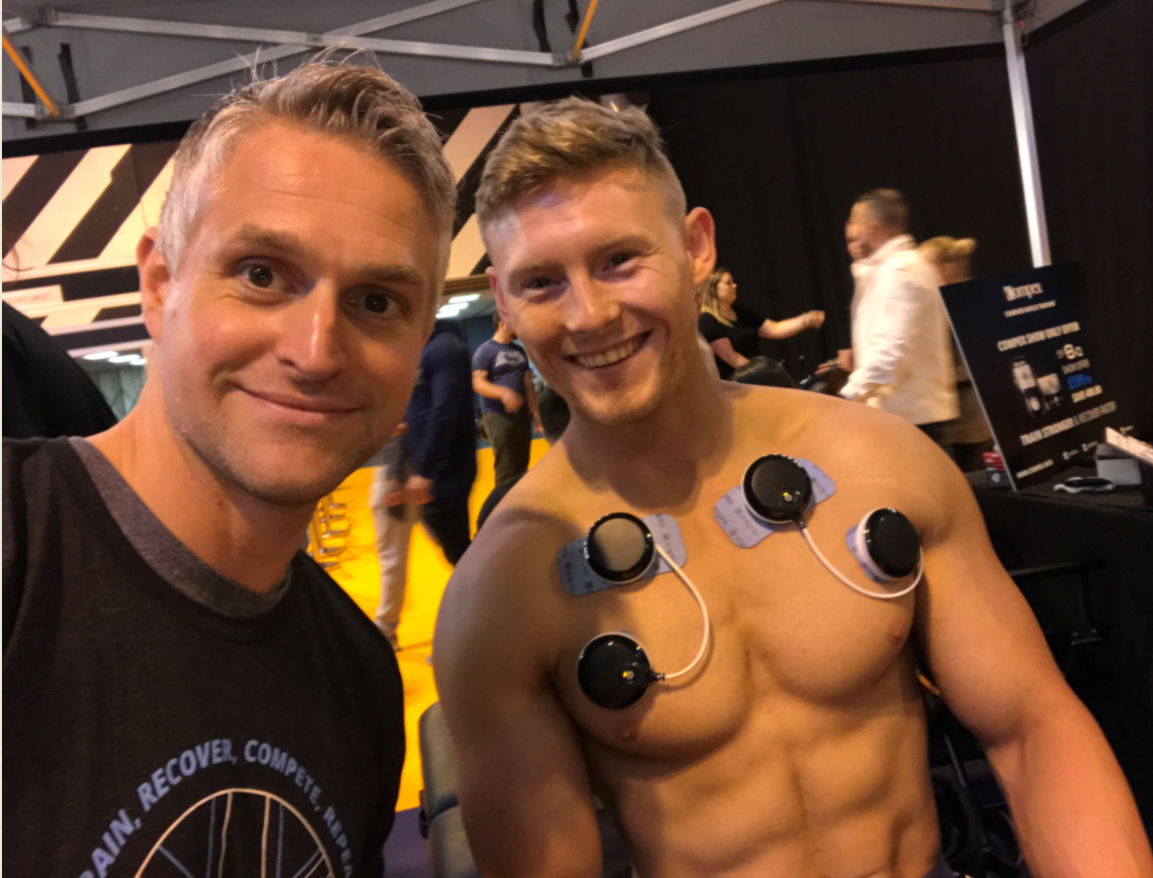
From strained pectorals whilst posing to recovery muscle stimulation in between Workouts, Compex was assisting athletes during all activities.
At Body Power I was taking my Physio
skills to the next level by treating Strongman athletes.
These guys are
awesome, huge and packed full of muscle.
They are too heavy for the Plinths so
we have to perform therapy of the floor in order to sort out their sore backs
from Deadlifting heavy weights, like a Vauxhall Corsa!
UK CrossFit legend, Will Kane was in
action at the Body Power Games and he popped by the Compex UK tent for some
treatment.
Cage Fighter, Alex Reid came for the
Compex experience to help him as he prepares his body for Mr Hampshire.
For some just walking around the
different displays at the NEC was enough to bring on Back Pain so it was Compex
to the rescue.